- Serving Michigan For Over 20 Years
- Over 8,000 properties restored
- Locally Owned & Operated



Why Grand Rapids Homes Need Crawlspace Waterproofing
Grand Rapids sits in a region that gets hit hard from every direction by moisture. The city receives roughly 38 inches of rain per year and an additional 76 inches of snow. That’s a tremendous volume of water cycling through the soil around your foundation every single year. Spring snowmelt alone can saturate the ground in a matter of days, and heavy summer storms only compound the problem.
What makes the situation worse is the soil itself. Much of the Grand Rapids area sits on clay-heavy soils that expand significantly when they absorb water and then contract as they dry. This expansion-contraction cycle creates constant lateral pressure against your foundation walls. Clay also drains poorly compared to sandy or loamy soils, so water lingers near the foundation far longer than it should. The Grand River and its tributaries contribute to a naturally high water table across many neighborhoods, particularly in lower-lying areas near Eastown and Heritage Hill, as well as on the southeast side, so any additional moisture can lead to elevated water retention and flooding.
For homes built on crawlspaces, this combination of heavy precipitation and expansive clay, paired with a high water table, creates a near-constant threat of groundwater intrusion. A dedicated waterproofing system isn’t a luxury in this climate. It’s a structural necessity.
Signs Your Crawlspace Has Moisture Damage
Most homeowners don’t spend much time thinking about what’s happening beneath their floors. The warning signs tend to show up in the living space long before anyone crawls underneath to investigate.
Musty odors are often the first clue. That stale, damp smell drifting up through your floorboards means moisture is accumulating below and organic material is breaking down. You might also notice doors that stick in their frames, gaps forming between the floor and your baseboards, or floors that slope noticeably toward the exterior walls. These symptoms point to structural movement caused by moisture weakening the supports beneath your home.
Uneven floors deserve particular attention. They’re typically caused by poor original construction, moisture causing settlement or rusting of support posts, deterioration of lumber such as beams and floor joists, or improper supports like rocks, bricks, or scrap lumber used in place of proper footings. By the time the floor visibly sags, the underlying damage is already significant.
Common Causes for a Wet Crawlspace
Water follows predictable paths into a crawlspace, and each path requires a specific solution. Understanding where the water comes from helps you understand why a one-size-fits-all approach doesn’t work.
Groundwater seepage is the most common culprit in Grand Rapids. After heavy rain or rapid snowmelt, the water table rises, and hydrostatic pressure pushes moisture upward through the soil and porous foundation walls. Cinder blocks are naturally porous and allow dampness to migrate through even when there are no visible cracks. This is a valid and common water entry point that many homeowners overlook.
Poor exterior drainage is the second major contributor. When the grade around your home slopes toward the foundation rather than away from it, every storm directs water straight to the crawlspace. Clogged gutters and short downspouts make the problem worse by dumping roof runoff directly against the foundation.
Cooling ducts running through the crawlspace can also be a source of water and moisture. When warm, humid air contacts the cold surface of ductwork, condensation forms and drips down, adding moisture to the space below.
Our Crawlspace Waterproofing Solutions
Bluebird CFW evaluates every crawlspace problem like engineers, not salesmen. We don’t recommend a product and hope it works. We diagnose the root cause of the moisture, then design a system that addresses it permanently. Our approach is comprehensive because crawlspace moisture rarely has just one source.
Crawlspace Encapsulation
Encapsulation involves installing a heavy-duty moisture barrier to seal out outside air and moisture. We place a thick, reinforced liner across the entire dirt floor and extend it up the foundation walls. All seams are overlapped and sealed. The result is a fully isolated environment beneath your home that stops ground vapor from rising into the living space. This helps with musty smells and ensures good indoor air quality throughout the house.
Sump Pumps and Drainage Systems
Managing bulk water requires more than a sealed barrier. We install interior drain tile systems to effectively manage water accumulation and direct it away from your home. The installation involves excavating a trench along the interior perimeter and placing a perforated drain pipe surrounded by 6A round stone. The collected water is then routed to a sump pump basin. A sump pump is always included with drain tile installation. The pump activates automatically when water reaches a set level and discharges it safely away from the foundation.
Dehumidification and Air Quality
Sealing the space and managing the water are two parts of the equation. Controlling the remaining humidity is the third. We install commercial-grade crawlspace dehumidifiers that maintain a consistent humidity level year-round. This prevents condensation from forming on floor joists and ductwork, which protects the wood from decay. It also keeps the air quality in your home clean and fresh.
Structural Repair and Support Jacks
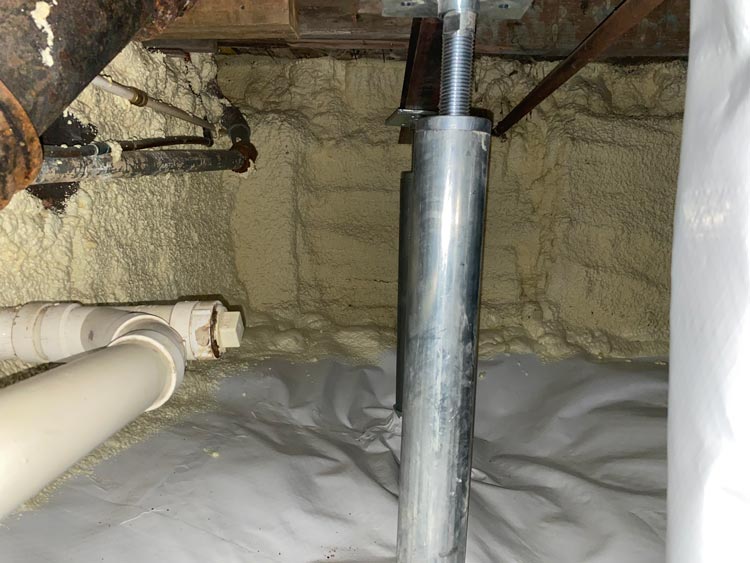
Moisture damage doesn’t stop at dampness. If water has already compromised your floor joists or beams, or if support posts have rusted and settled, we address that structural damage directly. For sagging or uneven floors, we install heavy-duty support posts and, where needed, replace deteriorated beams or floor joists. Waterproofing a crawlspace without first repairing the structure above it leaves the underlying problem in place. We fix the damage, then protect against future problems.
The Bluebird CFW’s Crawlspace Waterproofing Process
Our process is transparent and methodical. Each step builds on the one before it, and nothing gets skipped. Here’s what to expect.
Step 1: Free Inspection
We conduct a thorough evaluation of your crawlspace to identify the root cause of the moisture and assess any structural damage. Based on what we find, we determine the best course of action. There’s no cost for this inspection and no pressure to commit.
Step 2: Structural Repairs
If floor joists or beams have been compromised, or if support posts need replacement, we complete those repairs first. The home needs to be fully supported before any waterproofing system goes in.
Step 3: Drain Tile and Sump Pump Installation
We install the interior drainage system to capture and redirect groundwater. The sump pump is positioned at the lowest point of the crawlspace and connected to a discharge line that moves water well away from the foundation.
Step 4: Encapsulation
With drainage in place, we install the heavy-duty moisture barrier across the floor and up the walls, sealing the crawlspace from ground vapor and outside air.
Step 5: Insulation
We seal small openings along the sill plate and bond board (the transitional support components between your house and the concrete/masonry foundation) to prevent cold or hot air from entering from the exterior. This maintains consistent temperatures and prevents cold floors above in the winter.
Step 6: Dehumidifier Installation
A commercial-grade dehumidifier is set up to maintain optimal humidity levels going forward.
While each repair plan may differ slightly based on your home’s specific conditions, its execution will be very similar to this description.
Crawlspace Waterproofing Costs in Grand Rapids
Homeowners in the Grand Rapids area can expect the cost of a complete crawlspace waterproofing and encapsulation project to vary based on several specific factors. The total investment reflects the differences in crawlspace size, existing damage, and the specific components required for your home.
| Factor | How It Affects Cost |
| Crawlspace square footage | Larger spaces require more materials and labor. |
| Existing structural damage | Repairs to joists, beams, or posts add to the total. |
| Drainage system complexity | Homes with severe groundwater issues may need more extensive drain tile. |
| Vapor barrier thickness | Heavier-duty barriers cost more but last longer. |
| Dehumidifier | Commercial-grade units add to the project cost. |
We believe in transparent pricing. That’s why we offer free inspections to provide you with an exact quote before any work begins. We also offer easy financing options, low-interest payments, and no money down, so you can protect your home without financial strain.
Waterproofing vs. Encapsulation
These two terms get used interchangeably, but they address different problems. Understanding the distinction helps you make a better decision about what your home actually requires.
Waterproofing manages liquid water. If you have standing water after storms, a rising water table, or active leaks through the foundation walls, you need a drain tile system and a sump pump. The goal is to capture and remove bulk water before it pools in the crawlspace.
Encapsulation manages moisture vapor and humidity. It involves sealing the crawlspace with a heavy-duty moisture barrier to prevent damp ground air from rising into the living space above. Encapsulation helps with musty odors and maintains high indoor air quality.
| Feature | Waterproofing | Encapsulation |
| Primary goal | Remove and redirect liquid water | Control humidity and ground vapor |
| Key components | Interior drain tile, sump pump | Heavy-duty moisture barrier, sealed vents |
| Best for | Active water intrusion, standing water | Musty odors, humidity control, and air quality |
| Typical pairing | Often paired with encapsulation | Often paired with drainage |
Most Grand Rapids homes benefit from both systems working together. The waterproofing handles the groundwater, and the encapsulation controls the humidity. During your free inspection, we’ll assess your specific situation and recommend only what you actually need.
Why Choose Bluebird CFW?
With over 20 years of industry experience, our team understands Michigan’s unique soil conditions and how they affect your foundation. We’re a locally owned and operated business, and we’ve spent two decades solving exactly these problems for homeowners across West Michigan.
We provide a thorough inspection to identify the root cause of the issue and design a permanent repair plan. Our customized repair plans are designed to restore your crawlspace’s stability and give you long-term peace of mind. We don’t use high-pressure sales tactics. We explain what we find, present your options, and let you decide.
Every project is backed by a limited lifetime warranty. We also offer free inspections, easy financing options, low-interest payments, and no money down. Protecting your home shouldn’t be a financial burden, and we’ve structured our business to make sure it isn’t.
Frequently Asked Questions (FAQs)
You may be covered by your homeowner’s insurance depending on the source of the water damage and the specifics of your policy. Coverage varies significantly between providers. We always advise homeowners to check directly with their insurance company to understand what’s included before starting a project.
Most projects fall between $3,000 and $15,000. The exact cost depends on the size of your crawlspace, the materials selected, and whether structural repairs or drainage systems are needed. We offer free inspections to give you a precise, no-obligation estimate.
The primary benefits include moisture control, structural protection, improved indoor air quality, and decreased energy costs. By stopping groundwater intrusion and sealing out ground vapor, you protect your floor joists from decay, eliminate musty smells, and reduce the load on your heating and cooling systems.
Yes. We offer a limited lifetime warranty on our crawlspace waterproofing systems. We stand behind our work because we use proven methods and quality materials designed to last.
Most projects take between two and five days to complete. The timeline depends on the size of the crawlspace, the complexity of the drainage system, and whether structural repairs are required before waterproofing can begin.
Waterproofing alone won’t fix floors that have already sagged. If your floors are uneven, we install proper support posts and beams as part of the structural repair process before completing the waterproofing. The combination of structural repair and waterproofing addresses both the existing damage and the cause.
A dehumidifier is strongly recommended as part of a complete encapsulation system, particularly in Grand Rapids, where summer humidity is high. It maintains a consistent humidity level, prevents condensation from forming on cold surfaces, and keeps the sealed space dry year-round.
A basic vapor barrier involves laying a thin plastic sheet over the dirt floor to reduce ground moisture. Full encapsulation uses a much heavier, reinforced moisture barrier (typically 12 to 20 mil thick) that covers the floor, extends up the foundation walls, and seals all vents. Encapsulation creates a completely controlled environment, while a basic vapor barrier only partially reduces moisture.
The most common indicators are musty odors in the living areas above, sticking doors, gaps between the floor and trim, and floors that dip toward the outside walls. If you notice any of these signs, it’s worth scheduling a free inspection to determine what’s happening beneath your home.
Minor maintenance, like checking the sump pump or inspecting the vapor barrier, can be handled yourself. The actual installation of drain tile systems, sump pumps, and full encapsulation requires professional expertise and specialized equipment. An engineering-minded approach ensures the root cause is diagnosed and addressed correctly the first time, which saves you money over the long run compared to repeated DIY attempts.
The most common causes are hydrostatic pressure from a high water table pushing groundwater up through the dirt floor, poor exterior drainage that directs rainwater toward the foundation, and porous cinder block walls that allow dampness to migrate through. Clay soils compound the problem by holding water against the foundation rather than allowing it to drain away.
We recommend a brief visual inspection once a year. Check that the sump pump activates properly, the discharge line is clear, and the moisture barrier remains intact without tears or displacement. Annual inspections catch small issues before they become expensive repairs.